 Two Towers
Two Towers
Pick your towers, hold the gate, and see how long the city stands.
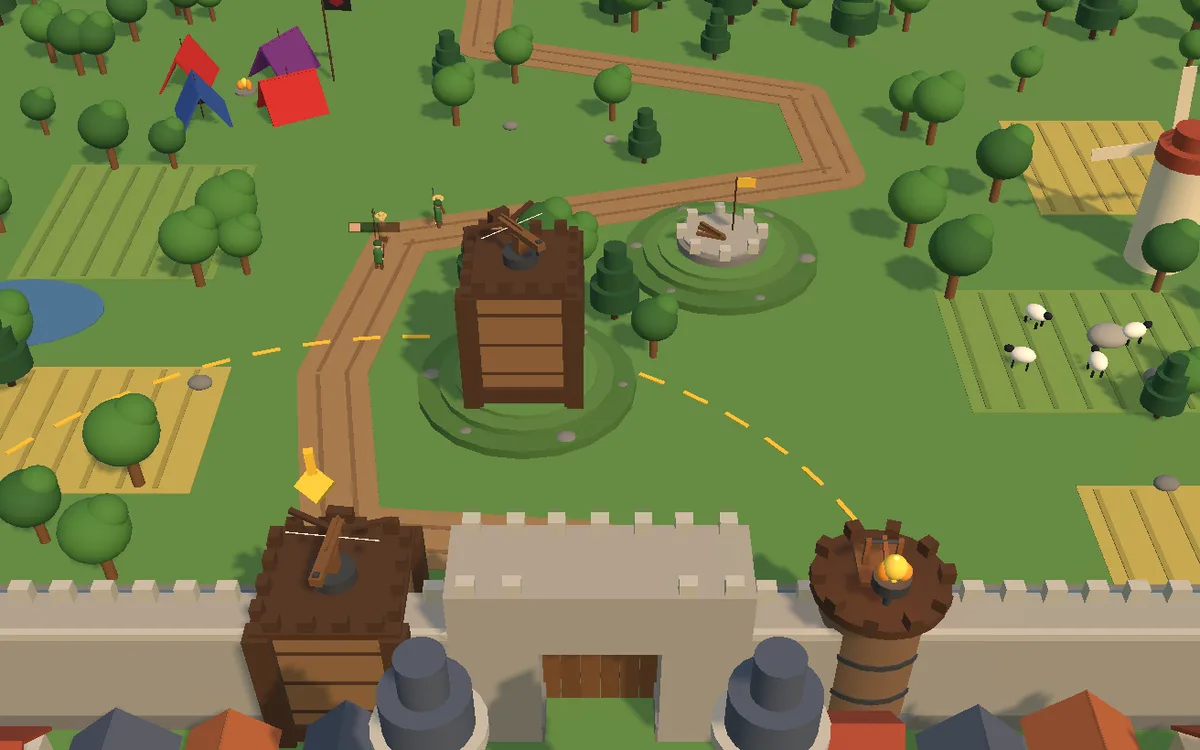
This game needs WebGL 2, which this browser does not offer. Try a current version of Chrome, Edge, Firefox or Safari.
Knights, monks, kings, archers, horsemen and battering rams march out of the woods on the city gate. Choose the two towers that guard it from four kinds, spend the gold you win on upgrades, and buy two more towers for the hills. Every stage comes stronger, faster or in greater numbers than the last, every five stages your towers enter a new age, and there is no final stage.
How to play
- Choose
- On the title screen, pick the tower for each side of the gate: Archer Tower, Trebuchet, Ballista or Fire Tower.
- Upgrade
- Click or tap a tower, on the field or in the tabs along the bottom, then buy damage, fire rate, range or its special.
- Build
- Buy a tower for West Hill or East Hill with gold: 150 for the first, 300 for the second, any of the four kinds.
- Gate
- Repair the gate or reinforce it for more strength. If it falls, the game is over.
- Keys
- Space pauses, F doubles the speed, M turns the sound off and N the music. Enter starts the next stage early.
What is on the field, and the history behind it
Towers
Archer Tower
Fast arrows at one attacker, and with Volley at up to four.
In history: A trained English longbowman could loose ten or more arrows a minute.
Trebuchet
Slow, long-range stones that hurt everyone where they land.
In history: A counterweight trebuchet, from the 12th century on, could hurl stones of 50 to 100 kilograms against walls.
Ballista
A heavy bolt through a line of attackers that ignores armor.
In history: The ballista, a giant crossbow, goes back to ancient Greece and Rome; medieval castles mounted similar bolt-throwers called springalds.
Fire Tower
Fire pots that leave the road burning, and fire burns through armor.
In history: Defenders threw burning pitch and, in Byzantium, Greek fire, whose exact recipe is still unknown.
Attackers
Peasant levy
Many and weak, with pitchforks.
In history: Lords could call up the men of their lands to fight, often with farm tools.
Archer
Stops short of the gate and shoots at it.
In history: Archers covered an assault by shooting at the defenders on the walls.
Knight
Armored: every hit loses a few points.
In history: By the 1400s a knight's plate armor turned most arrows, which is why crossbows and bolts mattered.
Monk
Heals the attackers around him.
In history: Monasteries kept infirmaries, and monks were among the few trained healers of the time.
Cavalry
Fast riders who reach the gate first.
In history: Mounted soldiers were the fastest troops on a medieval field.
Battering ram
Slow, heavily armored, and strikes the gate hardest.
In history: Rams were roofed and often hung with wet hides so defenders could not set them alight.
King
Every fifth stage: very strong, and hurries those around him.
In history: Medieval kings often led their armies in person, like Richard the Lionheart at Acre.
The castle
City gate
Repair it and reinforce it with gold between attacks.
In history: The gatehouse was a castle's weak point, so it was usually built as its strongest part.
Ages
Every five stages your towers are rebuilt stronger, from Timber to Legendary.
In history: Early castles were timber on earth mounds; stone castles replaced them from the 11th century on.